
If your childcare centre in Melbourne has ever failed a spot-check or had a parent complain about hygiene, the gap is almost always the same: no documented cleaning standard, no compliance-aligned schedule, and a cleaner who was never briefed on the difference between a general office wipe-down and a child-safe sanitisation protocol. Childcare cleaning Melbourne is not the same discipline as commercial office cleaning, and treating it that way puts your licence at risk. This guide breaks down exactly what the National Quality Framework requires, where most centres fall short, and what a properly structured cleaning program looks like in practice.
Table of Contents
- Why Childcare Cleaning Is a Compliance Issue, Not Just a Housekeeping Task
- The National Quality Framework and Your Cleaning Obligations
- What Childcare Centre Hygiene Actually Requires Room by Room
- Cleaning Frequency Schedules That Satisfy Regulators
- Comparing Cleaning Approaches for Childcare Centres
- Childcare Cleaning Standards Australia: Chemical Safety and Product Selection
- What to Look for in a Childcare Cleaning Provider in Melbourne
- Frequently Asked Questions
- References
Why Childcare Cleaning Is a Compliance Issue, Not Just a Housekeeping Task
The Australian Children’s Education and Care Quality Authority (ACECQA) does not grade cleaning quality on a curve. Under the National Quality Standard (NQS), Quality Area 2 covers children’s health and safety, and assessors specifically look at whether your hygiene and infection-control practices are documented, followed, and verifiable. A dirty nappy change table or a sink without a proper handwashing routine is not just unpleasant. It is a direct path to a rating of Working Towards National Quality Standard, which parents can look up.
In practice, Melbourne childcare directors who treat cleaning as a facilities afterthought rather than a compliance pillar tend to discover the gap during assessment, not before it. That is the wrong time to find out.
The National Quality Framework and Your Cleaning Obligations
The National Quality Framework (NQF) sets the legal and operational baseline for all approved childcare providers in Victoria. Regulation 77 of the Education and Care Services National Regulations specifically requires that premises, furniture, and equipment are maintained in a safe and clean condition. Regulation 88 requires that nappy change areas are cleaned and sanitised after each use. These are not suggestions.
What Regulation 77 Means for Your Cleaning Schedule
Regulation 77 is broad enough that it gives assessors significant discretion to cite non-compliance. A bin that has not been emptied, a toilet block that smells of urine, or play equipment with visible grime are all legitimate triggers. The practical standard is not “cleaned once a day” but “maintained in a clean condition throughout operating hours.” That distinction matters because it means reactive cleaning during the day is not optional.
Approved Provider Responsibility Under Regulation 168
Regulation 168 requires approved providers to have a written policy on hygiene. Many directors do have such a policy on paper, but it is not aligned with their actual cleaning contract. A common mistake is having an internal policy that references TGA-approved disinfectants and then using a cleaning contractor who brings generic supermarket products. If your assessor asks to see the products being used, that mismatch is immediately visible.
“Healthy environments in early childhood settings require consistent, documented hygiene practices that go beyond basic tidiness. They must address infection prevention as a measurable outcome.” – Australian Institute of Health and Welfare, Childcare and Early Childhood Learning data framework guidance
What Childcare Centre Hygiene Actually Requires Room by Room
Generic cleaning checklists do not work in childcare environments because each zone carries a different contamination risk. Childcare centre hygiene standards recognise at least four distinct risk zones, and each one demands a different protocol, frequency, and product selection.
Nappy Change and Bathroom Areas: Highest Risk Zone
These areas require sanitisation after every single use during operating hours, and a full deep clean at the end of each day. The surface disinfectant must be a TGA-listed product with demonstrated efficacy against common pathogens including rotavirus and hand-foot-mouth disease virus. Products must also be safe for surfaces that children touch immediately after cleaning. This rules out bleach-heavy formulas on soft-close surfaces or timber benching.
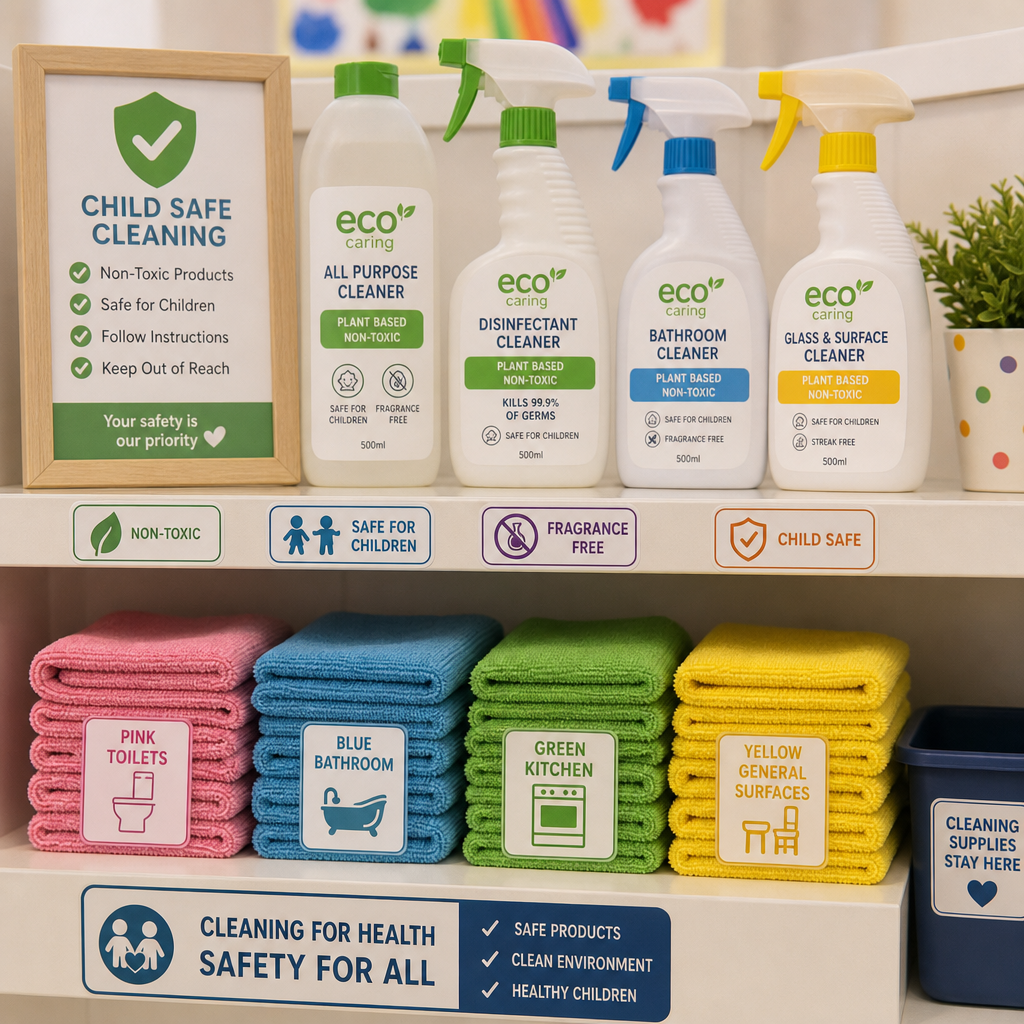
In practice, this means your cleaning contractor needs to carry separate product kits for bathrooms versus classrooms. A cleaner who uses the same spray bottle across your centre is not meeting the standard, regardless of how clean things look.
Classrooms and Play Areas: Medium to High Risk Zone
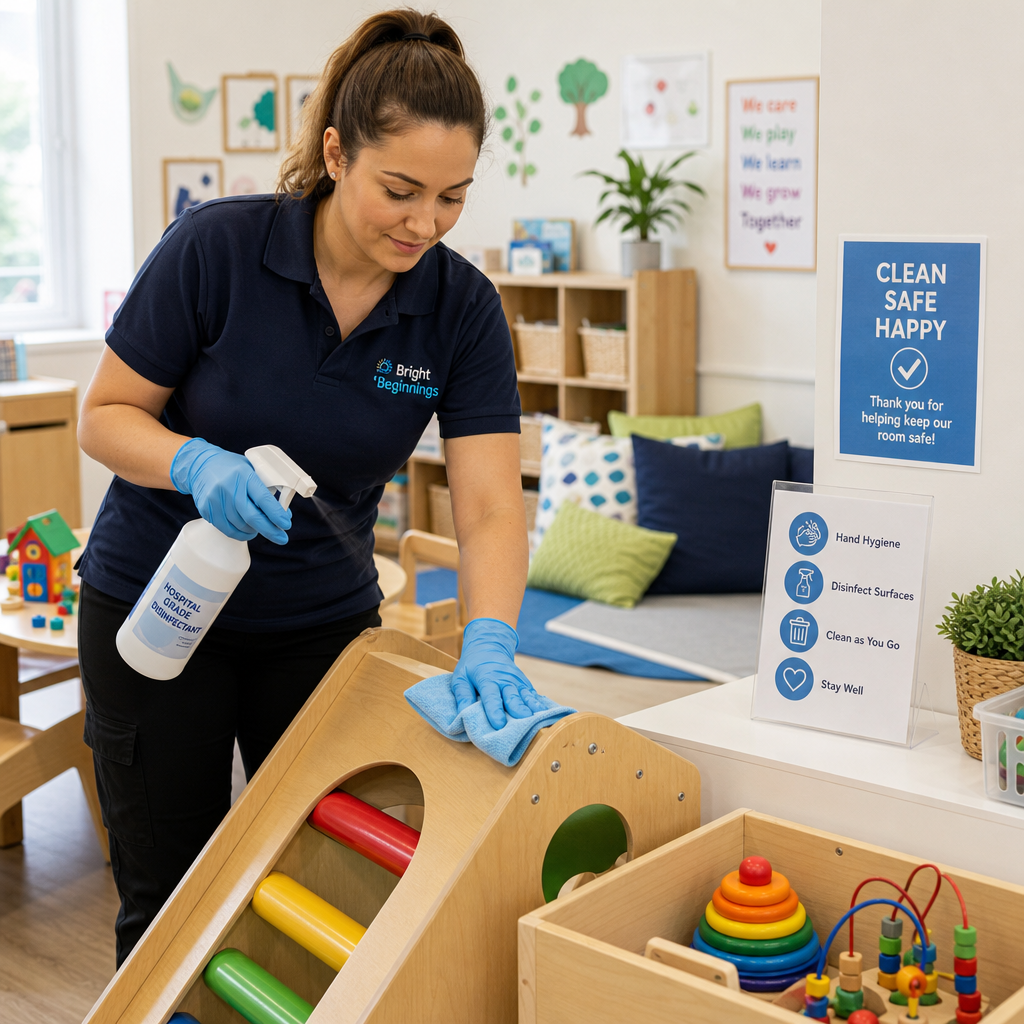
Hard surfaces including tables, chairs, and play equipment frames need daily disinfection with a food-safe or child-safe grade product. Soft furnishings including cushions and fabric book corners are a frequently missed category. These should be laundered or sanitised at minimum weekly and immediately following any illness outbreak. Floor cleaning must use a mop-and-bucket system that prevents cross-contamination between rooms, meaning separate mop heads per room or a colour-coded system.
Kitchen and Food Preparation Areas
These fall under both childcare hygiene regulations and Food Act 1984 (Victoria) requirements. Benches, cutting boards, and sink areas require food-grade sanitiser applied after every meal preparation session. The cleaning log for this area should be separate from the general cleaning record, and staff should be able to show it to both childcare and food safety assessors.
Cleaning Frequency Schedules That Satisfy Regulators
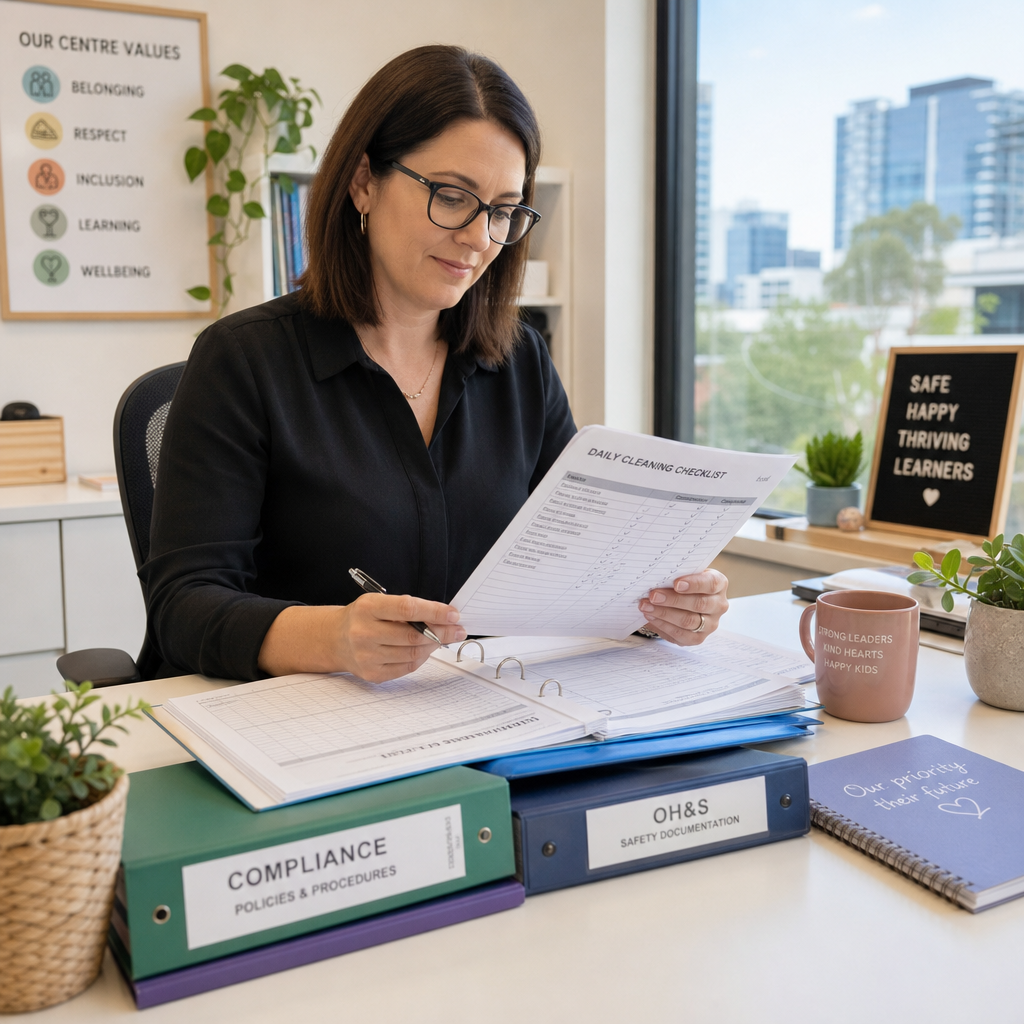
The data consistently shows that the single most common compliance gap in childcare cleaning is not the quality of the cleaning itself but the absence of a documented schedule with sign-off records. Assessors want evidence, not just clean surfaces. A centre that keeps a daily cleaning log signed by the cleaner and countersigned by a staff member is in a fundamentally stronger position than one that relies on a cleaner’s word.
Minimum recommended frequency by task:
Nappy change bench: sanitise after every use, full clean end of day
Bathrooms and toilets: clean and disinfect at least twice daily during operating hours
Classroom hard surfaces: disinfect once daily, spot-clean as required
Kitchen food contact surfaces: sanitise after each use
Floors (hard surface): mop with disinfectant once daily minimum
Soft furnishings: launder or sanitise weekly, immediately after illness event
Outdoor play equipment: clean weekly, inspect daily for debris and contamination
High-touch points (door handles, light switches, taps): disinfect twice daily
Pro tip: Create a laminated cleaning schedule poster for each room and require the cleaner to initial after each completed task. This takes under five minutes per room and is often the difference between a Exceeding NQS rating and a Working Towards rating during a quality assessment visit.
Comparing Cleaning Approaches for Childcare Centres
Directors in Melbourne often ask whether they should use an in-house cleaner, a general commercial cleaning company, or a specialist childcare cleaning provider. Each approach has real trade-offs, and the answer depends on your centre size, budget, and compliance risk tolerance.
Cleaning Approach | Key Advantages | Key Risks and Limitations |
|---|---|---|
In-house staff cleaner | Immediate availability, familiar with the centre layout, easy to supervise | Requires ongoing training in childcare-specific protocols, sick leave coverage gaps, higher direct employment cost and liability |
General commercial cleaning company | Cost-competitive, flexible scheduling, insured | Not trained in NQF compliance requirements, may use non-approved products, no specialist knowledge of nappy area protocols or infection control |
Specialist childcare cleaning provider (e.g., Vibrant Property Services) | Trained in NQF and ACECQA compliance, uses TGA-listed child-safe products, provides documented cleaning logs, understands risk-zone protocols across all room types | Higher cost than a general provider, requires clear briefing on centre-specific layout and schedule |
The honest position here is that a general commercial cleaning company is the highest compliance risk option for a childcare centre. They are not trained in NQF standards, and they will not know the difference between a food-safe sanitiser and a general-purpose disinfectant. If your current provider cannot name the TGA registration number of their disinfectant products, that is a red flag worth acting on.
Childcare Cleaning Standards Australia: Chemical Safety and Product Selection
Under childcare cleaning standards Australia, the Therapeutic Goods Administration (TGA) registers disinfectants used in healthcare and high-risk environments. While childcare is not classified as a healthcare facility, best practice guidance from the National Health and Medical Research Council (NHMRC) explicitly recommends TGA-registered disinfectants for childcare sanitisation tasks involving nappy changes and bodily fluid cleanup.
What Products Are Acceptable in Childcare Environments
Acceptable products must be effective against the specific pathogens common in childcare settings, including norovirus, rotavirus, RSV, and hand-foot-mouth disease. They must also be safe for child contact after a defined drying or contact time, which is typically listed on the product label. Products containing phenols, high-concentration quaternary ammonium compounds, or strong oxidising agents are generally not appropriate for surfaces that children will touch or mouth immediately after cleaning.
Fragrance-free and hypoallergenic formulations are strongly preferred in rooms where children with asthma or sensitivities are present. This is not just a welfare consideration. It also reduces the risk of respiratory complaints from parents, which can trigger regulatory follow-up.
Storage and Handling Requirements
All cleaning chemicals must be stored in a locked area inaccessible to children, per Regulation 97 of the Education and Care Services National Regulations. MSDS (Material Safety Data Sheets) for every product used on site must be accessible to staff. A cleaning provider who cannot supply MSDS documentation is not compliant with your obligations as an approved provider, even if you are not the one handling the chemicals.
Pro tip: Ask your cleaning provider to supply a product register including TGA registration numbers and MSDS sheets when you sign the contract. Update this register annually. If they cannot provide it, treat that as a disqualifying factor, not a minor admin gap.
What to Look for in a Childcare Cleaning Provider in Melbourne
Melbourne has no shortage of cleaning companies willing to take on a childcare contract. Very few of them understand what that contract actually requires. The difference between a compliant provider and a non-compliant one is not immediately visible on a price comparison, but it becomes very visible during an ACECQA assessment.
When evaluating a childcare cleaning provider, ask these questions directly:
Can you provide a written cleaning schedule aligned with NQF Quality Area 2 requirements?
What disinfectants do you use, and are they TGA-listed?
Do your staff hold Working With Children Checks?
How do you handle an illness outbreak protocol, including same-day deep clean requests?
Do you use colour-coded equipment to prevent cross-contamination between bathroom and kitchen zones?
Can you provide a daily cleaning log with staff signatures for compliance documentation?
Vibrant Property Services has delivered specialist childcare cleaning across Melbourne for over 15 years. Their team operates with documented room-by-room protocols, child-safe TGA-listed products, and cleaning logs designed specifically for NQF compliance reviews. For directors who want a provider that understands the difference between cleaning a nappy change area and cleaning a boardroom, that experience matters.
The competitors in this market, including general commercial operators, typically lack NQF-specific training for their staff. That gap creates genuine compliance exposure for childcare directors who assume all insured cleaning companies are interchangeable.
Frequently Asked Questions
How often should a childcare centre in Melbourne be professionally cleaned?
At minimum, a professional deep clean should occur daily after operating hours covering all rooms, surfaces, and bathrooms. During the day, reactive cleaning of nappy change areas, toilets, and kitchen surfaces must also occur after each use. A weekly deep clean of soft furnishings, outdoor equipment, and high-contact zones is also required to maintain NQF compliance. Some centres with higher enrolments or illness events require more frequent scheduled cleans.
Are childcare cleaning standards in Australia legally enforceable?
Yes. The Education and Care Services National Regulations, which apply in Victoria and all other states, create legal obligations around premises cleanliness, nappy change area sanitisation, and chemical storage. Non-compliance can result in improvement notices, conditions placed on your service approval, or in serious cases, suspension of your approved provider status. ACECQA assessors examine cleaning practices as part of Quality Area 2 assessments.
Do childcare cleaners need a Working With Children Check in Victoria?
Yes. Any person who works at a childcare centre, including contractors such as cleaners, must hold a valid Working With Children Check if they are in contact with children or working in the centre environment when children are present. Even if cleaning occurs after hours, best practice and many approved provider policies require it. Always request evidence of a current check before any contractor begins work on your premises.
What is the difference between cleaning, sanitising, and disinfecting in a childcare context?
Cleaning removes visible dirt and debris using detergent and physical action. Sanitising reduces the number of pathogens on a surface to a safe level, typically used on food contact surfaces. Disinfecting kills a broader spectrum of pathogens and is required for bathroom surfaces, nappy change areas, and any surface involved in bodily fluid contact. All three steps are required in a compliant childcare cleaning program. Using only one step, usually basic cleaning, is the most common mistake seen in non-compliant centres.
Can a childcare centre use the same cleaning company as their office space?
Technically yes, but practically it creates significant compliance risk. General commercial cleaners are trained for office environments, not regulated childcare hygiene protocols. They typically do not carry TGA-listed disinfectants, do not follow room-specific contamination prevention procedures, and are not familiar with NQF reporting requirements. If you use a shared provider, you must provide them with a written childcare-specific protocol and verify their product compliance before each service. Most directors find it simpler and safer to use a specialist.
How should a childcare centre handle a gastro or illness outbreak in terms of cleaning?
An illness outbreak requires an immediate response clean using a TGA-listed disinfectant with confirmed efficacy against the relevant pathogen, for example a norovirus-appropriate product during a gastro event. All surfaces in the affected room must be cleaned, sanitised, and disinfected in sequence. Soft furnishings must be removed and laundered. The cleaning must be documented with time, products used, and staff signature. Your cleaning provider should have an outbreak response protocol available before an event occurs, not sourced during one.
If you are a childcare director in Melbourne currently reviewing your cleaning contract or preparing for an ACECQA assessment, we would like to hear what hygiene challenges you are navigating right now. Share your experience or question below and we can address it directly.
References