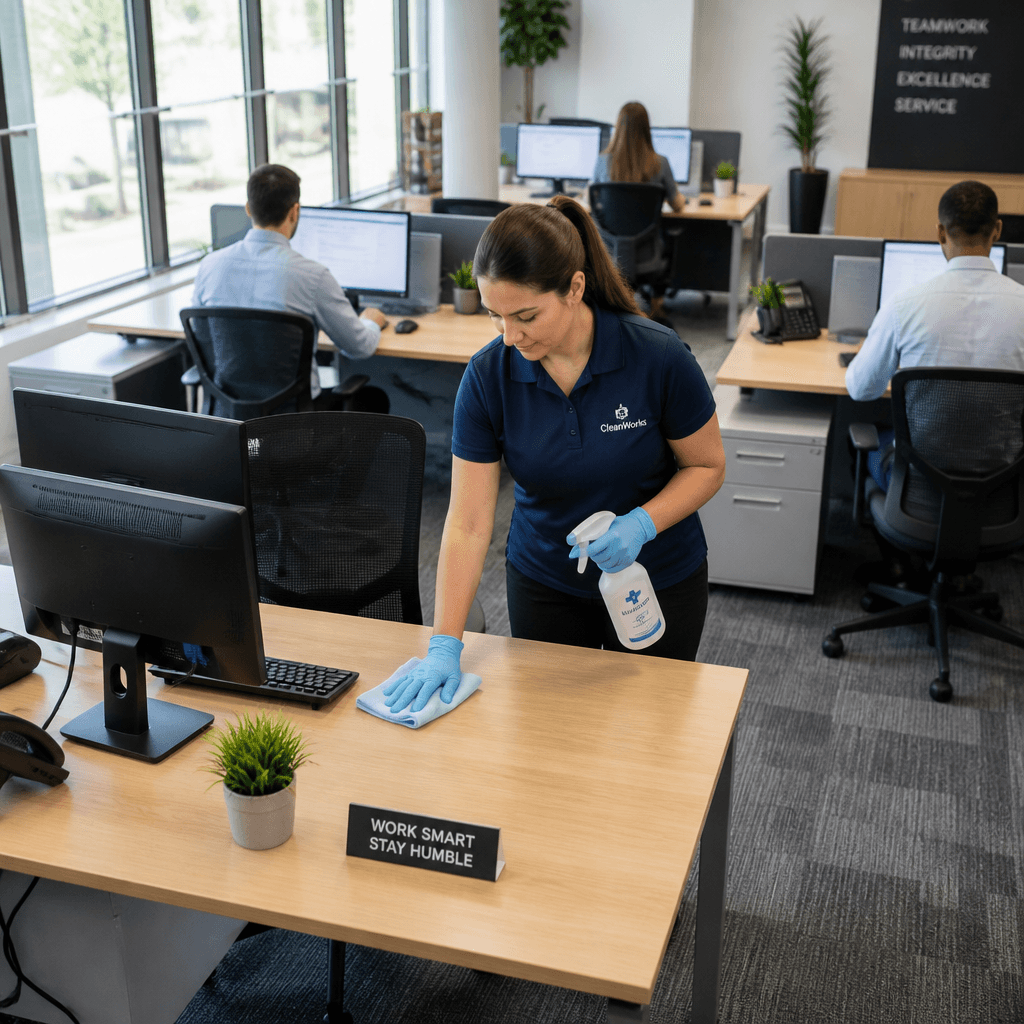

Most Melbourne facility managers ask the same question before switching suppliers: do green cleaning products actually clean, or do they just make the invoice look responsible? It is a fair question. Eco-friendly cleaning Melbourne services have grown sharply in the past five years, but the market is crowded with products that smell like eucalyptus and do very little else. The answer, based on real commercial cleaning experience across offices, childcare centres, aged care facilities, and medical environments, is that the right green products work. The wrong ones do not. The difference is knowing which category you are buying.
Table of Contents
- Quick Takeaways
- What Makes a Cleaning Product Genuinely Green
- Performance Comparison: Green vs Conventional in Commercial Settings
- Which Commercial Environments Benefit Most from Eco-Friendly Cleaning
- Green Cleaning Products Commercial: The Australian Certification Landscape
- Sustainable Cleaning Services Melbourne: What to Actually Look for in a Provider
- Comparison Table: Three Approaches to Commercial Cleaning in Melbourne
- Frequently Asked Questions
- References
Quick Takeaways
| Key Insight | Explanation |
|---|---|
| Certification separates real green products from greenwashing | In Australia, look for GECA (Good Environmental Choice Australia) or EPA Safer Choice equivalents. A product labelled “natural” without certification tells you nothing useful. |
| Eco-friendly disinfectants can meet hospital-grade standards | Products based on hydrogen peroxide or citric acid formulations have demonstrated pathogen kill rates comparable to chlorine bleach in controlled studies, making them viable for medical and aged care environments. |
| Dilution ratios determine real-world cost, not the bottle price | Many commercial green concentrates require significantly less product per square metre than conventional alternatives, reducing per-clean cost despite higher upfront pricing. |
| Indoor air quality improves measurably with green product use | Conventional cleaners containing VOCs (volatile organic compounds) elevate indoor air pollutant levels. Switching to low-VOC green products can reduce indoor VOC concentrations by up to 50%, according to research published in environmental health journals. |
| Green cleaning does not mean slower cleaning | Dwell time and application method matter more than whether a product is synthetic or plant-derived. Trained technicians using green products clean at the same rate as those using conventional products. |
| Childcare and aged care sites have the most to gain from the switch | Vulnerable occupants absorb chemical residues through skin contact and inhalation more readily than healthy adults. Reducing chemical load in these environments is a direct risk-reduction measure, not just a marketing position. |
| Not all green cleaning services in Melbourne are equivalent | A provider must be able to name their specific products, show safety data sheets, and demonstrate compliance with relevant Australian Standards. Vague commitments to “eco-friendly” practices are not sufficient. |
What Makes a Cleaning Product Genuinely Green
The term “eco-friendly” has no legal definition in Australia. Any manufacturer can print it on a label without meeting any standard whatsoever. This is the first thing commercial property managers and facility operators need to understand before evaluating any cleaning supplier’s claims about sustainability.
A genuinely green cleaning product meets several specific criteria. It must be biodegradable within a defined timeframe, typically 28 days under OECD 301 testing protocols. It must not contain compounds classified as aquatic toxins, carcinogens, or endocrine disruptors under standard hazard classification systems. And it must achieve its cleaning or disinfecting function without relying on those harmful compounds as active agents.
In practice, this means looking for formulations built around plant-derived surfactants, hydrogen peroxide, citric acid, lactic acid, or enzymatic action. These ingredient classes have decades of peer-reviewed research supporting both their effectiveness and their lower environmental and human health burden compared to phosphate-based or chlorinated conventional alternatives.
Pro tip: Ask any cleaning supplier to provide the Safety Data Sheet (SDS) for every product they use. A legitimate eco-friendly product will have a low hazard rating in Section 2 of its SDS. If a supplier cannot produce the SDS on request, that is a compliance problem, not just a transparency problem.

Performance Comparison: Green vs Conventional in Commercial Settings
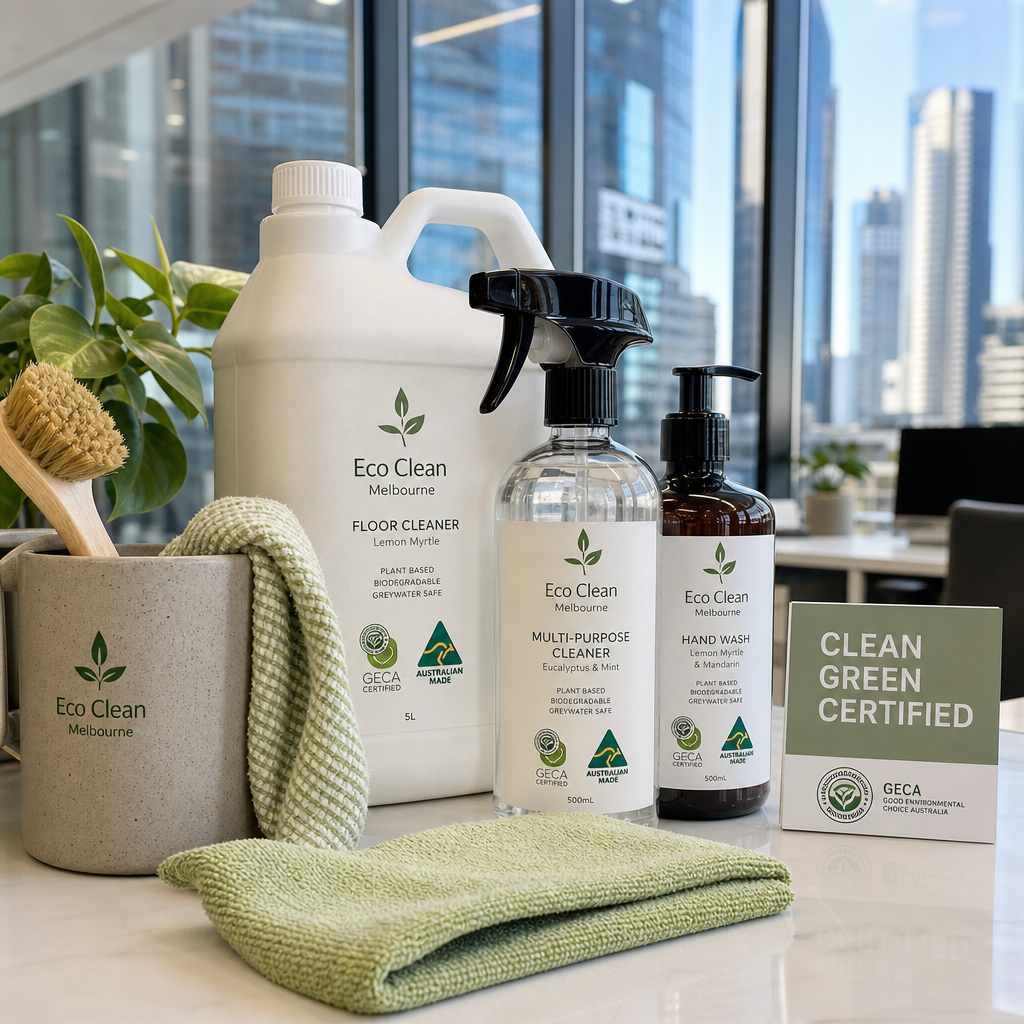
The persistent myth in facility management is that green products require trade-offs, that you accept slightly worse performance in exchange for a feel-good sustainability story. The data consistently shows this is outdated thinking, though it was not always wrong. Early-generation green cleaning products from the 1990s and early 2000s genuinely underperformed. The chemistry has improved substantially since then.
Disinfection and Pathogen Kill Rates
Hospital-grade disinfection requirements in Australia are governed by the Therapeutic Goods Administration (TGA). Several hydrogen peroxide-based green disinfectants now hold TGA registration as hospital-grade disinfectants. This means they have passed the same kill-rate testing as conventional quaternary ammonium or chlorine-based products. For medical cleaning, childcare cleaning, and aged care cleaning, this removes the primary performance objection to using green options.
A common mistake is assuming that all pathogens respond equally to all disinfectant classes. They do not. A qualified cleaning provider will match the disinfectant type to the organism risk profile of each site, whether green or conventional. This is a technical skill, not a product selection issue.
Grease, Soil, and Heavy Buildup in Commercial Kitchens and Warehouses
Heavy-duty degreasing is the area where green products most frequently disappoint when chosen without technical guidance. Plant-based degreasers work well on light-to-medium soiling. For heavy industrial grease in warehouse environments or commercial kitchen exhaust systems, some conventional alkaline degreasers still outperform the available green alternatives. An honest provider will tell you this rather than selling you a one-size-fits-all green solution that leaves grease behind.
That said, enzymatic cleaners represent a rapidly improving category. Enzyme-based products digest organic matter biologically rather than dissolving it chemically. For waste areas, drains, and food preparation surfaces with organic soil buildup, they outperform conventional cleaners on a 24-48 hour dwell basis, while being genuinely benign in their environmental profile.
Which Commercial Environments Benefit Most from Eco-Friendly Cleaning
Not every commercial environment has equal motivation to switch to green cleaning products. The business case is stronger in some settings than others, and a credible cleaning provider should be able to tell you where you sit on that spectrum rather than recommending the same approach to every client.
Childcare Centres
Children aged zero to five absorb chemical residues at significantly higher rates than adults due to their higher surface-area-to-body-mass ratio and hand-to-mouth behaviour. Residues from conventional quaternary ammonium disinfectants on toys, mats, and hard surfaces create ongoing low-level chemical exposure that accumulates over a full day in care. Switching to GECA-certified or TGA-registered green disinfectants in childcare environments is a direct duty-of-care decision, not optional.
Vibrant Property Services works specifically with childcare centres across Melbourne and applies cleaning protocols that prioritise low-residue, low-VOC products as a baseline standard for these environments, not as an optional upgrade.
Aged Care Facilities
Elderly residents with respiratory conditions, including COPD and asthma, are disproportionately affected by airborne VOCs from conventional cleaning products. Several case studies from Australian aged care providers have documented measurable improvement in resident respiratory symptom frequency following switches to low-VOC cleaning programmes. This is not anecdotal. It is a documented outcome with practical implications for facility managers who are managing both care quality and operational liability.
Office and Hotel Environments
Sustainable cleaning services Melbourne businesses most commonly request are in the office and hotel sector, driven largely by ESG reporting requirements. Corporations with sustainability targets increasingly require their facility management suppliers to document the environmental profile of all cleaning products used on their premises. A cleaning provider that cannot supply product environmental data becomes a liability in this procurement environment, regardless of price.
Green Cleaning Products Commercial: The Australian Certification Landscape
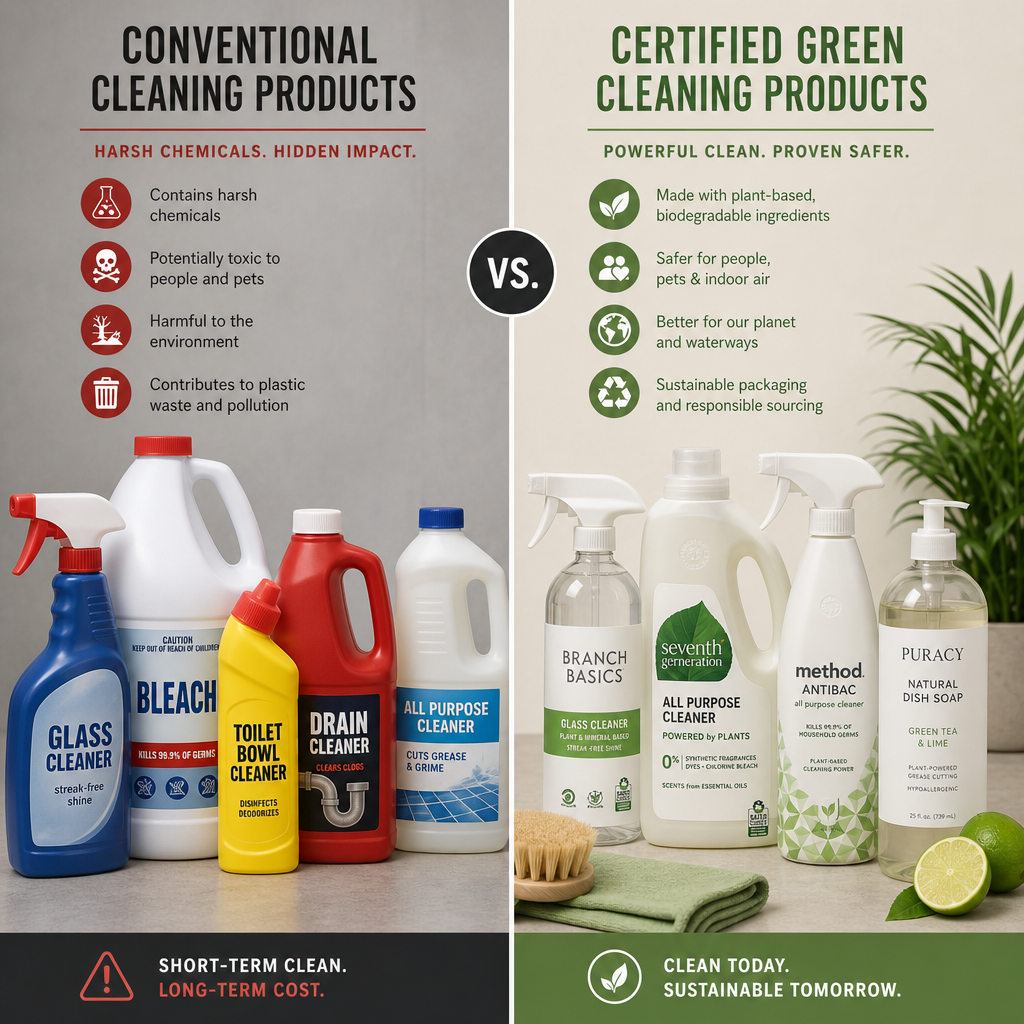
Understanding Australian certification schemes is not optional for any facility manager making a genuine commitment to green cleaning. The labels matter because they separate independently verified claims from marketing language.
GECA (Good Environmental Choice Australia) is the primary independent ecolabel operating in Australia. Products certified by GECA have been assessed against specific environmental and human health criteria by a third party. GECA certification for cleaning products evaluates biodegradability, aquatic toxicity, packaging, and VOC content. It is the most directly relevant certification for commercial cleaning product purchasing decisions in Australia.
Beyond GECA, the EPA Safer Choice program (US-origin but used as a reference standard by some Australian suppliers) and the European Ecolabel provide additional reference points when assessing imported products. The TGA registration, as noted above, applies specifically to disinfectants and sanitisers and is not an ecolabel but a performance and safety registration.
“Procurement decisions based on vague sustainability claims rather than verified certification expose facilities to both reputational and regulatory risk. The certification infrastructure exists precisely to prevent this.” — Good Environmental Choice Australia (GECA) guidance documentation
A common mistake among property managers is treating all green certifications as equivalent. They are not. A product certified under GECA has been assessed against criteria specific to the Australian regulatory and environmental context. A product with an overseas-only certification may not meet Australian environmental or safety standards. Always check that the certification is current and covers the specific product, not just the manufacturer’s range in general.
Pro tip: Request a product list with certification numbers from any cleaning provider before signing a service agreement. A credible supplier will have this information ready. A supplier who responds with a general statement about using “environmentally friendly” products without being able to provide certification references is not operating a genuine green cleaning programme.
Sustainable Cleaning Services Melbourne: What to Actually Look for in a Provider
The Melbourne commercial cleaning market has a significant number of providers who claim eco-friendly credentials without the operational practices to back them up. Differentiating genuine sustainable cleaning services from greenwashed marketing requires asking specific operational questions, not evaluating website language.
Staff Training on Green Product Protocols
Green cleaning products often require different application techniques than conventional products. Enzyme-based cleaners require specific dwell times. Hydrogen peroxide disinfectants have concentration-dependent kill rates that require correct dilution. A cleaning team that applies green products using conventional application habits will get poor results and will then incorrectly attribute those poor results to the product rather than the technique. Ask any prospective provider specifically how their staff are trained on green product protocols.
Microfibre and Water-Efficiency Practices
Genuine sustainable cleaning programmes combine low-impact chemistry with low-impact physical methods. Microfibre cleaning systems reduce water consumption and chemical usage simultaneously, and they remove biofilm more effectively than conventional mop-and-bucket systems at equivalent chemical concentrations. A provider operating a real eco-friendly cleaning programme will be using microfibre systems as standard, not as a premium add-on.
Waste and Packaging Reduction
A cleaning supplier using concentrated green products that are diluted on-site generates significantly less plastic packaging waste than one supplying pre-diluted ready-to-use products. For Melbourne businesses with waste reduction targets, this operational detail affects your facility’s total waste footprint directly. It is worth asking about concentrate ratios and packaging take-back programmes when evaluating suppliers.
Vibrant Property Services has built its commercial cleaning programmes around these operational principles across Melbourne’s diverse commercial sectors, from builder’s cleans through to ongoing aged care facility maintenance. The approach is consistent: match the product to the environment, verify the certification, train the team on the method, and document the outcomes.
Comparison Table: Three Approaches to Commercial Cleaning in Melbourne
| Approach | Performance Profile | Best Suited For |
|---|---|---|
| Conventional Chemical Cleaning (phosphate-based, quaternary ammonium, chlorinated) | High kill rates for standard pathogens. Effective on heavy industrial soiling. Higher VOC output. Aquatic toxicity risk from wastewater. Higher residue load on surfaces. | Heavy industrial sites, situations requiring rapid broad-spectrum disinfection where no certified green alternative has equivalent TGA registration |
| Certified Green Cleaning (GECA-certified or TGA-registered green disinfectants, plant-derived surfactants) | Comparable disinfection performance for most commercial pathogen profiles. Low VOC output. Biodegradable. Lower residue load. May require longer dwell time for heavy organic soiling. | Childcare centres, aged care facilities, medical environments, offices, hotels, schools, any site with vulnerable occupants or ESG reporting requirements |
| Hybrid Programme (certified green products as primary, conventional as targeted exceptions) | Maximises green chemistry use while retaining conventional products for specific high-demand applications such as heavy industrial degreasing. Requires documented product selection protocols. | Warehouses, supermarkets, mixed-use commercial facilities, builder’s cleaning post-construction where varied soil types are present across the same site |
Frequently Asked Questions
Are eco-friendly cleaning products effective enough for hospital-grade disinfection in Melbourne?
Yes, but only if you select products that hold TGA registration as hospital-grade disinfectants. Several hydrogen peroxide-based formulations now meet this standard. The key is verifying TGA registration for the specific product, not assuming all green disinfectants meet hospital-grade requirements. Vibrant Property Services uses TGA-registered disinfectants in medical and aged care environments as a non-negotiable standard.
Do green cleaning products cost more than conventional ones for commercial sites?
The upfront product cost is often higher, but the per-clean cost is frequently equivalent or lower when you account for dilution ratios and reduced PPE requirements. Concentrated green products used by professional cleaning services typically dilute at rates that offset the higher purchase price. Factor in reduced liability exposure in sensitive environments and the cost equation shifts further in favour of green options.
What certifications should I ask for when choosing eco-friendly cleaning in Melbourne?
For general cleaning products, GECA certification is the primary Australian standard to request. For disinfectants, ask for TGA registration as a hospital-grade or commercial-grade disinfectant. For imported products, EU Ecolabel or EPA Safer Choice certification provides reference-level assurance. Any supplier unable to produce current certification documentation for their specific products is not operating a verified green cleaning programme.
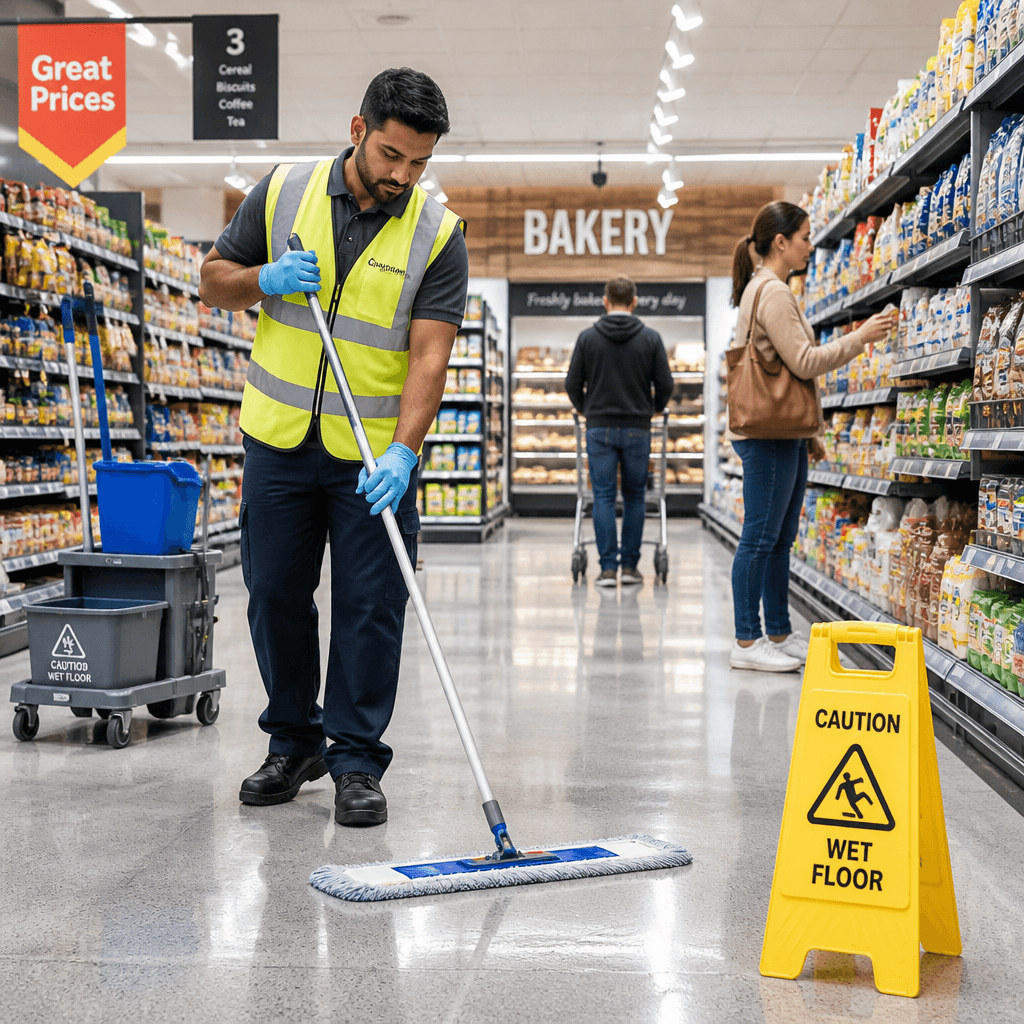
Can green cleaning products handle the demands of high-traffic commercial spaces like supermarkets or warehouses?
In most areas, yes. Floor cleaning, general surface disinfection, toilet facility maintenance, and glass cleaning all have well-proven green product options that perform comparably to conventional alternatives in high-traffic environments. Heavy industrial degreasing remains the most challenging application category, and some sites benefit from a hybrid approach that uses conventional degreasers in specific high-demand areas while applying green products elsewhere.
How do I verify that a Melbourne cleaning company is genuinely using eco-friendly products and not just claiming to?
Request the product list with brand names, product codes, and certification numbers before signing any agreement. Then cross-reference the certification numbers with the GECA database or the TGA registered product database. Ask to see Safety Data Sheets for the key products. A genuine eco-friendly cleaning service will have all of this available without hesitation. Resistance or vagueness in response to these requests is a clear signal that the green credentials are marketing rather than operational reality.
Does switching to sustainable cleaning services affect cleaning frequency or scheduling for commercial properties?
No, and any provider suggesting you need more frequent cleaning as a result of switching to green products is either using inferior green products or misapplying them. Properly selected and applied green cleaning products maintain commercial hygiene standards on standard cleaning schedules. The scheduling factors that matter are foot traffic volume, soil load, and occupant sensitivity, not whether the chemistry is green or conventional.
If you manage a commercial property in Melbourne and have tried green cleaning products with mixed results, or have questions about how to evaluate what your current provider is actually using, share your experience below. It helps other facility managers make better-informed decisions.
References
- United States Environmental Protection Agency: research and standards on safer cleaning product chemistry and indoor air quality
- World Health Organization: guidelines on infection prevention and the role of disinfectants in healthcare and care facility environments
- Australian Therapeutic Goods Administration: registration database and standards for hospital-grade and commercial-grade disinfectants in Australia
- Australian Government Department of Health: guidance on cleaning and disinfection standards in healthcare and aged care settings
- Statista: market data on the global green cleaning products industry, growth trends, and commercial adoption rates