
A Melbourne school with 500 students generates an extraordinary volume of daily contact points. Door handles, shared desks, bathroom taps, canteen benches, library tables – each one a potential transfer point for bacteria, viruses, and allergens. Yet many schools treat cleaning as a box-ticking exercise rather than a health strategy. The result is predictable: higher absenteeism, more illness outbreaks, and reactive cleaning that costs more than prevention. Professional school cleaning in Melbourne is not just about appearance. It is about building an environment where students can actually focus on learning instead of getting sick.
Table of Contents
- Quick Takeaways
- Why School Cleaning Is Different from Standard Commercial Cleaning
- Victorian Department of Education Cleaning Standards
- High-Risk Zones in Every Melbourne School
- Choosing the Right Educational Facility Cleaning Provider
- Cleaning Approaches Compared
- How Vibrant Property Services Approaches School Cleaning
- Frequently Asked Questions
- References
Quick Takeaways
| Key Insight | Explanation |
|---|---|
| Daily cleaning is the baseline, not the gold standard | The Victorian Department of Education mandates daily cleaning for most areas. High-contact zones often need attention multiple times per day during peak periods. |
| WWCC compliance is non-negotiable for school cleaners | Every cleaner working on a Melbourne school campus must hold a valid Victorian Working With Children Check (WWCC). No exceptions, regardless of whether students are present. |
| Canteens and bathrooms carry the highest infection risk | Food preparation surfaces and bathroom fixtures combine moisture, organic matter, and heavy traffic – a reliable combination for bacterial and viral spread. |
| Eco-safe products are not optional in educational settings | Children are more vulnerable to harsh chemical residues than adults. Child-safe, certified cleaning products protect students and staff without compromising hygiene outcomes. |
| Performance-based contracts outperform time-based ones | Under the Victorian government’s model, cleaners must meet a required standard, not simply complete a task list in a set time. The same expectation should apply when schools engage private providers. |
| Holiday and term-break cleaning is a compliance requirement | Deep cleaning during school holidays is mandated under the Department of Education’s framework. It is not an optional add-on – it is the mechanism that resets hygiene baselines before each term. |
| Consistent, dedicated teams produce better hygiene outcomes | Rotating casual staff do not build familiarity with a school’s layout, problem areas, or protocols. A dedicated team notices when something is wrong before it becomes a reportable issue. |
Why School Cleaning Is Different from Standard Commercial Cleaning
Most commercial cleaning contracts assume a relatively predictable environment: offices, retail spaces, or warehouses where the population is adult, consistent in number, and capable of maintaining basic hygiene habits. Schools operate on a completely different model.
Hundreds of children move through the same spaces every day, touching every surface within reach, sharing equipment, and spending long periods in enclosed rooms. Classrooms, libraries, and corridors accumulate layers of contact contamination that a standard mopping schedule simply does not address. Educational facility cleaning requires a layered approach that accounts for both visible dirt and invisible microbial risk.
There is also a legal and compliance dimension that does not apply to office cleaning. Melbourne schools operate under the oversight of the Victorian Department of Education, the National Quality Standard framework for early learning environments, and general Victorian occupational health and safety obligations. A cleaning provider that does not understand these frameworks creates compliance risk for the school, not just a cleanliness problem.
Pro tip: When evaluating a school cleaning provider, ask whether they can supply documentation that aligns with your school’s compliance register. Verbal assurances are not sufficient. A reputable provider will have written records of tasks completed, products used, and team credentials available on request.

Victorian Department of Education Cleaning Standards
The Victorian Department of Education operates a centrally managed cleaning contract system for metropolitan Melbourne schools. Under the current framework, five providers have been appointed across ten areas under cleaning services agreements, with the most recent agreements coming into effect in late 2024. The model is performance-based: cleaners must meet a required standard for every cleanable area, not simply show up and work through a checklist.
The Department’s Cleaning Standards and Frequency Guide specifies daily cleaning as the minimum requirement for most areas, with daily checks built into the schedule. Periodic deep cleaning during term breaks is also a mandated component of the framework, not an optional service upgrade. This holiday cleaning is the mechanism through which hygiene baselines are reset before each new term.
What Performance-Based Cleaning Actually Means in Practice
Performance-based cleaning shifts accountability from process to outcome. The question is not “did a cleaner visit this room today?” but “does this room meet the required standard?” This is a meaningful distinction for school business managers and principals. It means that if a standard is not met, the provider is required to return and correct it, regardless of how much time was originally allocated.
For schools engaging private commercial cleaning providers outside the central contract, applying the same performance-based logic is sound practice. Specify the standard you expect for each area in your agreement, not just the frequency of visits. A provider that can only commit to “three visits per week” without defining what clean looks like at the end of each visit is offering very little.
The measure of a school cleaning program is not how often cleaners arrive but whether the environment meets a defined hygiene standard after they leave. Frequency without accountability is just scheduling.
High-Risk Zones in Every Melbourne School
Not every area of a school carries equal risk. Knowing where contamination concentrates is the starting point for any serious cleaning program. These are the zones that consistently demand the most attention.
Classrooms and Shared Learning Spaces
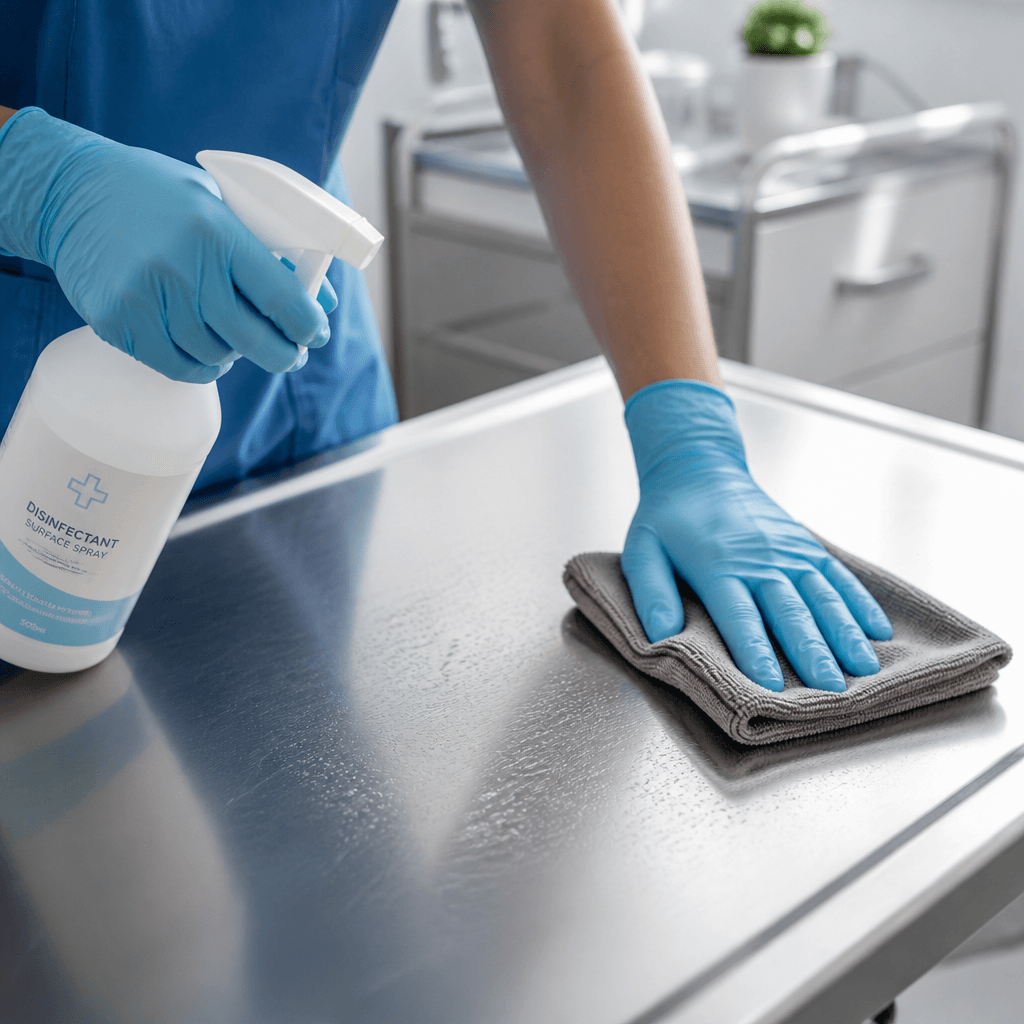
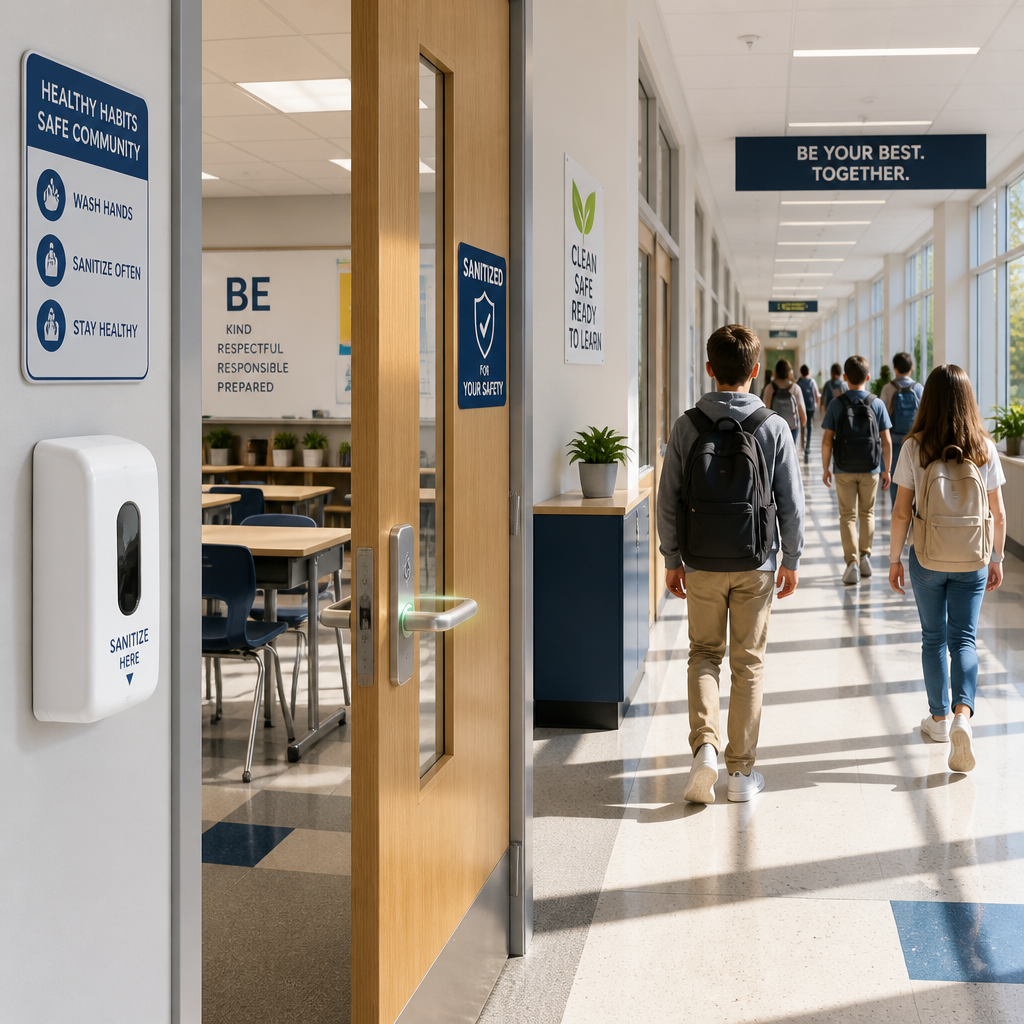
Desks, chairs, door handles, light switches, and shared equipment are the primary contact surfaces in any classroom. During flu season and viral outbreaks these surfaces act as transfer points across the entire student cohort. Cleaning must go beyond sweeping and mopping. Disinfecting high-touch surfaces with appropriate, child-safe products is a daily requirement, not a weekly task. Whiteboards, shared technology equipment, and manipulative learning materials also need scheduled attention that many basic cleaning contracts miss entirely.
Bathrooms and Amenities
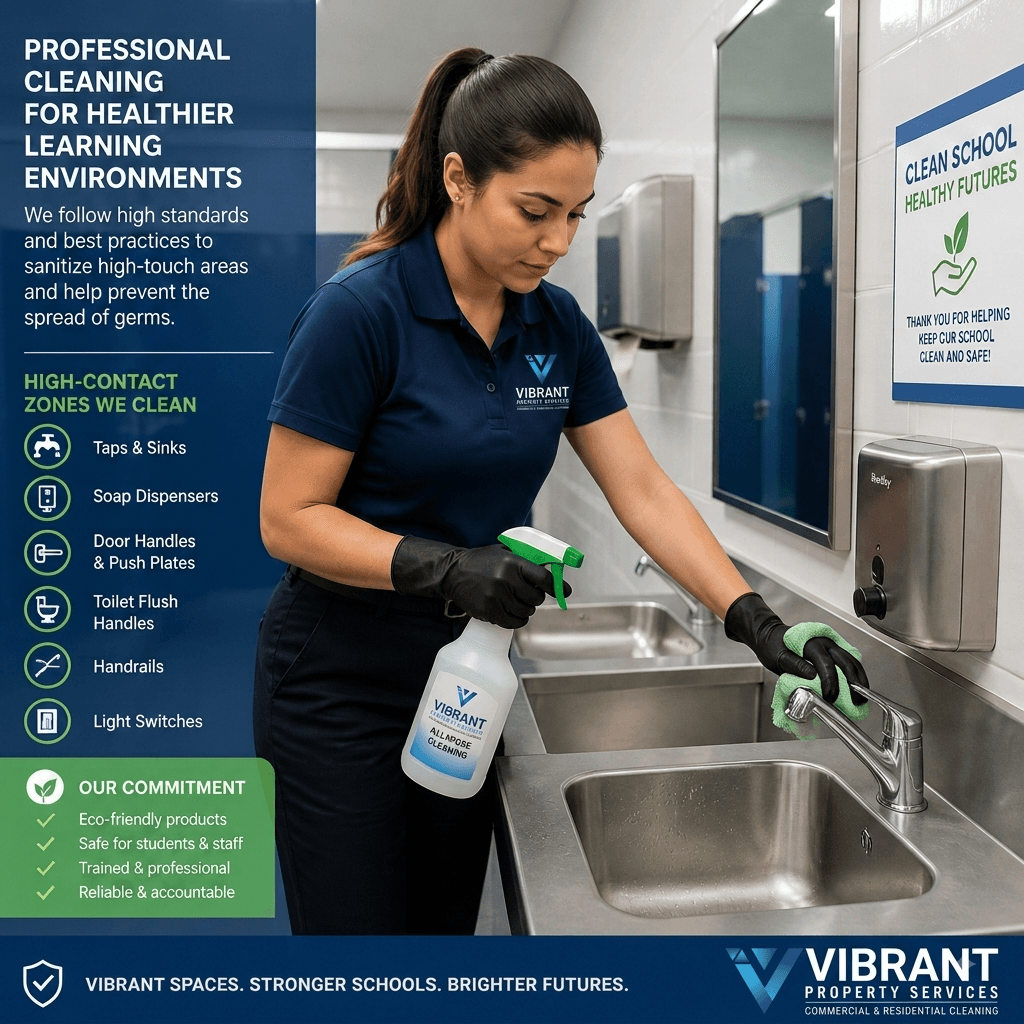
School bathrooms are the highest-risk zones on any campus. High volume, poor ventilation in older buildings, and the hygiene habits of school-age children combine to create conditions where bacteria and viruses establish themselves quickly. Toilet seats, taps, soap dispensers, and door handles all require disinfection, not just cleaning. Bathrooms should be checked and serviced multiple times per day in a well-run school, not just at the end of the day.
Canteens and Food Preparation Areas
Canteens must meet food safety standards that go beyond general commercial cleaning. Preparation surfaces, serving zones, and dining areas require comprehensive sanitisation that complies with health department regulations. This is a specialist task. A general cleaning provider without food-safe sanitisation protocols and the right chemical certifications should not be cleaning your canteen.
Pro tip: In Melbourne schools, canteen cleaning compliance often intersects with local council food safety requirements in addition to the Department of Education’s standards. Confirm that your cleaning provider understands both sets of obligations before signing a contract.
Gymnasiums, Halls, and High-Traffic Corridors
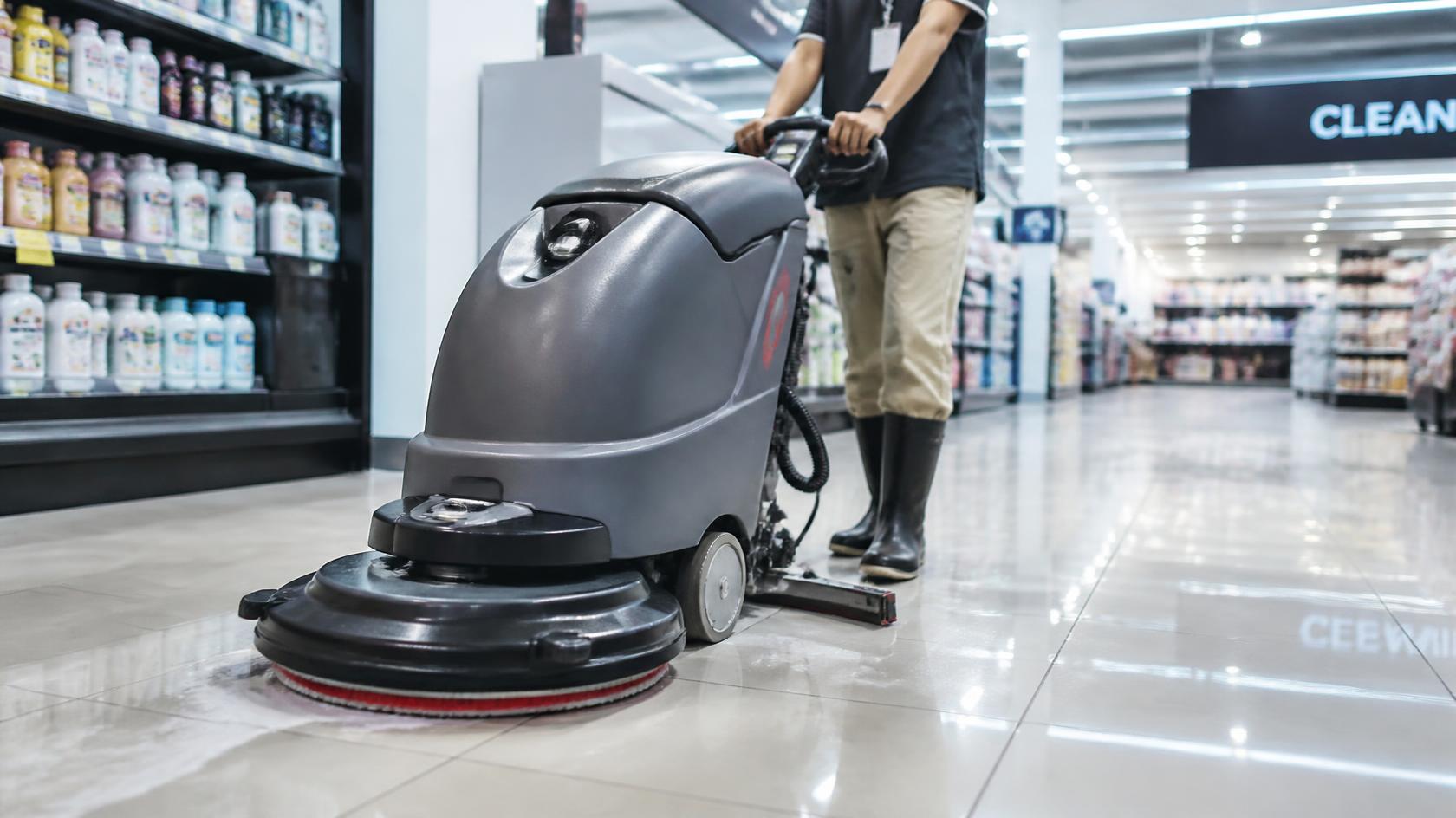
Large gathering spaces and corridors present a different problem: sheer volume of foot traffic combined with surfaces that are rarely given the same attention as classrooms. Hard floors in corridors can harbour allergens and fine particulate matter that standard mopping redistributes rather than removes. Gymnasiums add sweat, skin contact surfaces, and shared equipment to the mix. HEPA-filter vacuuming and appropriate floor care are not premium features in these spaces. They are baseline requirements.
Choosing the Right Educational Facility Cleaning Provider
The market for commercial cleaning for schools in Melbourne is crowded. Separating providers who genuinely understand educational environments from those who have simply added “schools” to their service list takes some deliberate evaluation.
Non-Negotiable Credentials
Every cleaner deployed to a Melbourne school campus must hold a valid Victorian Working With Children Check (WWCC) and have undergone a National Police Check. These are not optional. A provider who cannot confirm these credentials for every team member, or who cannot produce documentation for your compliance register, is not a viable option for an educational environment, regardless of how competitive their pricing is.
Product Safety and Environmental Certification
Children are significantly more sensitive to chemical residues than adults. Harsh cleaning agents that are acceptable in industrial or warehouse settings can cause respiratory irritation and skin reactions in school environments. Look for providers using products with recognised safety and environmental certifications. GECA-certified or equivalent child-safe products are a reasonable baseline requirement for any school cleaning contract in Melbourne.
Staff Consistency Over Casual Rotation
A common mistake in school cleaning procurement is treating the lowest price as the primary selection criterion. Low-cost providers often achieve that price point through high staff turnover, casual rotation, and minimal training. The practical consequence for a school is that no individual cleaner develops familiarity with the campus layout, the problem areas, or the school’s operational rhythms. A dedicated, consistent team notices when a bathroom exhaust fan has stopped working, when a particular classroom generates unusually heavy traffic, or when a new area has been opened up that needs to be added to the schedule. Rotating casuals notice none of this.
Cleaning Approaches Compared
Comparing School Cleaning Service Models in Melbourne
| Approach | Best Suited For | Key Limitations |
|---|---|---|
| In-house school cleaning staff | Large campuses with dedicated facilities management budgets and HR capacity | High overhead for recruitment, training, payroll, equipment, and compliance management. Leave coverage creates service gaps. WWCC management falls on the school. |
| Central Department of Education contracted cleaning (metropolitan Melbourne) | Government schools in metropolitan Melbourne under the Department’s centrally managed model | Limited flexibility for schools with specific needs outside the base service scope. Schools must supplement for specialist tasks such as window cleaning, high-pressure washing, or tile restoration. |
| Private specialist commercial cleaning provider | Independent schools, Catholic schools, specialist schools, and government schools needing supplementary or specialist cleaning beyond the base contract | Quality varies significantly between providers. Schools must conduct their own due diligence on credentials, product safety, and performance standards. Price competition can mask service gaps. |
For most independent and Catholic schools in Melbourne, engaging a private specialist commercial cleaning for schools provider offers the most flexibility. The key is choosing based on demonstrated capability in educational environments, not on price alone.
How Vibrant Property Services Approaches School Cleaning
Vibrant Property Services brings over 15 years of experience across regulated and high-compliance environments in Melbourne, including schools, childcare centres, aged care facilities, and medical environments. This cross-sector experience matters for school cleaning because the hygiene expectations in aged care and childcare translate directly to educational settings: vulnerable occupants, strict product safety requirements, documented compliance, and zero tolerance for inconsistency.
Vibrant’s school cleaning services cover the full campus: classrooms, corridors, bathrooms, canteens, gyms, libraries, and outdoor amenities. For schools that need services beyond routine cleaning, the team also handles window cleaning, high-pressure cleaning for external surfaces and walkways, and tile and grout restoration for bathroom and canteen areas that standard mopping cannot adequately maintain over time.
Documentation and Compliance Records
For schools in regulated sectors or those preparing for quality audits, Vibrant generates job completion records that log date, time, tasks completed, and the supervising team member. These records are formatted to align with compliance registers rather than being generic service logs. This is the difference between a provider who cleans schools and a provider who understands what school administration actually needs from a cleaning partner.
Scheduled Cleaning Across Melbourne and Surrounding Suburbs
Vibrant services schools and educational facilities across Melbourne and surrounding suburbs. Cleaning schedules are built around each school’s operational calendar, including term-break deep cleaning, not applied from a generic commercial template. Schools operate differently from offices and warehouses, and the cleaning program needs to reflect that reality.
If your school needs a cleaning partner who already understands the compliance, credential, and documentation requirements of educational environments, explore Vibrant Property Services’ approach to educational and childcare facility cleaning or review their sector-specific cleaning schedule framework to understand how they build programs around compliance requirements rather than generic schedules.
Frequently Asked Questions
How often should classrooms be cleaned in Melbourne schools?
The Victorian Department of Education sets daily cleaning as the minimum standard for classrooms under its central metropolitan contract. High-touch surfaces, including desks, door handles, and shared equipment, should be disinfected daily. During illness outbreaks or peak flu season, additional mid-day checks and disinfection of high-contact surfaces are a practical necessity, not a premium service.
Do school cleaners in Melbourne need a Working With Children Check?
Yes. Every person working on a Melbourne school campus, including cleaning staff, must hold a valid Victorian Working With Children Check (WWCC) and should also have completed a National Police Check. This applies whether or not students are present during cleaning hours. Any provider who cannot confirm this for every team member deployed to your campus should not be engaged.
What cleaning products are safe to use in schools with children present?
Child-safe, certified cleaning products are required in educational environments. Harsh industrial chemicals, strong bleach solutions, and products with significant VOC content are not appropriate for classrooms, libraries, or canteens where children are present or will be present shortly after cleaning. Look for products with recognised environmental and safety certifications, such as GECA-certified products, and confirm your provider’s product list before signing any contract.
What specialist cleaning services do Melbourne schools typically need beyond routine cleaning?
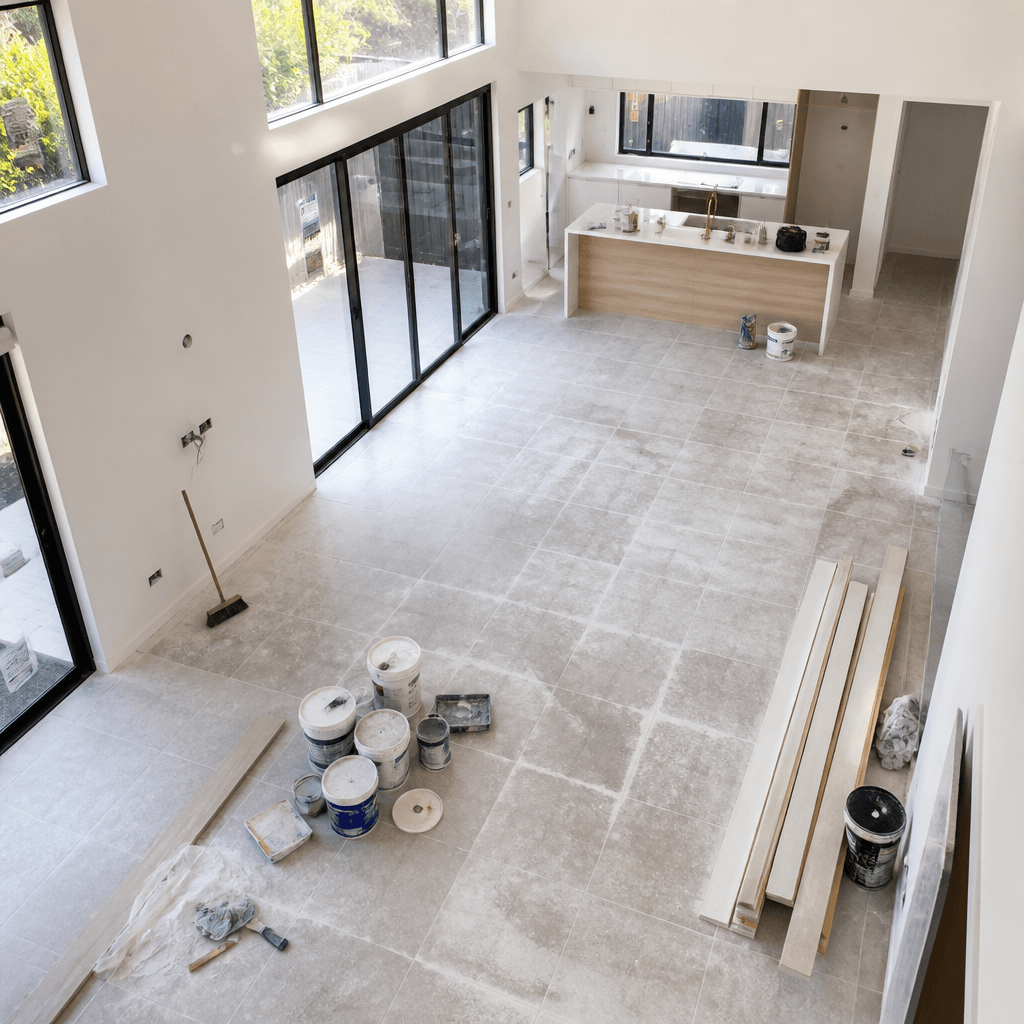
Beyond routine daily and holiday cleaning, Melbourne schools commonly require window cleaning for multi-storey buildings, high-pressure cleaning for external walkways, driveways, and play areas, tile and grout restoration for bathroom and canteen floors that accumulate staining and biological matter over time, and builders’ cleaning after any renovation or construction work. A full-service commercial cleaning provider can cover all of these under one contract rather than requiring the school to manage multiple separate vendors.
How should a school evaluate whether a commercial cleaning provider is actually performing to standard?
Define the standard in writing before the contract starts: what does “clean” look like for each area, and what is the response time if a standard is not met? Request regular quality audit reports and job completion documentation. Conduct periodic walkthroughs with the provider’s area manager, not just with the cleaning team. A provider who resists documented performance accountability is one whose performance you should be concerned about.
Is term-break deep cleaning mandatory for Melbourne schools?
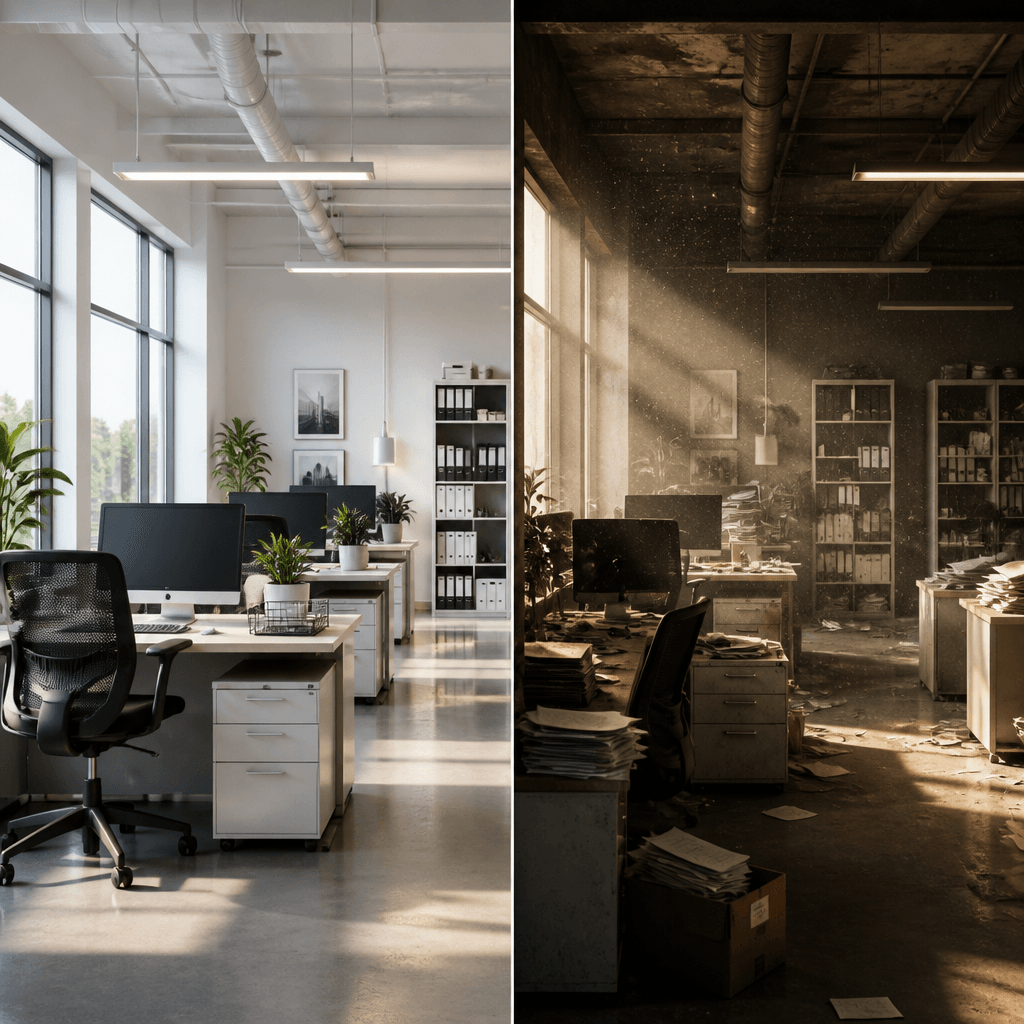
Under the Victorian Department of Education’s framework for metropolitan Melbourne schools, periodic cleaning during term breaks is a mandated component of the cleaning services plan, not an optional extra. For independent schools outside the central contract, term-break deep cleaning is strongly advisable as the mechanism for resetting hygiene standards before each new cohort of students arrives. Skipping it means each term begins with accumulated contamination from the previous one.
Have you dealt with inconsistent cleaning standards at your school, or found an approach that works particularly well? Share your experience in the comments – your perspective is useful to other facility managers and school business managers navigating the same challenges.
References
- Victorian Department of Education school cleaning policy, performance standards, and metropolitan contract framework
- Victorian Department of Education cleaning resources including the Cleaning Standards and Frequency Guide for primary, secondary, and specialist schools
- Comprehensive overview of educational facility cleaning and sanitisation requirements for Melbourne schools
- Guide to maintaining hygiene standards in Melbourne childcare and school facilities, including high-risk zones and product safety